Saturday, 5 March 2011

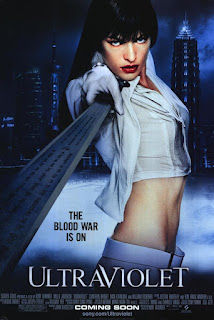
Ultraviolet

The Resident Evil franchise may have made Milla Jovovich the queen of mid-budget science-fiction films, but even she can’t save this truly abysmal futuristic vampire flick.

Normally, we’d begin with a brief plot synopsis. Unfortunately, the confused array of sequences which collectively comprise Ultraviolet (2006) defy coherent summary. At least the story, whatever it is, provides Ms Jovovich with plenty of opportunities to wear tight-fitting clothing and expose her perfectly toned mid-riff, so it’s not all bad. 

Let’s fast-forward to our primary interest in the film: the exploding helicopter. During one of the substandard, Matrix-inspired action sequences, Jovovich jumps on a motorcycle to escape a pursuing helicopter. 

Riding directly up the side of a skyscraper – the laws of physics have no function in this film – she evades a heavy bombardment of machinegun fire. As the helicopter’s gunner runs out of ammunition, Jovovich halts her flight before turning round and racing towards the chopper as the gunner tries desperately to reload.

Milla roars off the top of the building through the open sides of the helicopter. As she passes through the chopper she shoots the pilot and gunner dead, before crashing through into another building. Behind her, the helicopter explodes for an indeterminate reason.  

Artistic merit 

The undoubted highlight of this dumpster fire of a film. It’s spectacular, innovative and very cool. Even if the CGI is rather shoddy.

Exploding helicopter innovation

A similar scene can be seen in the low budget Filipino action Final Score (1986). In that film, the hero drops a grenade into the helicopter’s cockpit as he rides through the fuselage.  

Interesting fact 

Director Kurt Wimmer disowned the film after it was re-edited by the studio who cut out 30 minutes of footage.  

Review by: Jafo

Still want more? Then check out the Exploding Helicopter podcast on Ultraviolet. Listen via iTunes, Podomatic, Stitcher, and Acast.


Sunday, 27 February 2011

Superman II

General Zod, Ursa and Non escape from their cling film prison in space and come to Earth. They wash up in a small town where they’re confronted by the US army.

With the nation’s media watching their every move they engage in a demonstration of their awesome powers. Having seen off flame throwers, rocket launchers and assorted army vehicles, a helicopter is called up and fires missiles at the Kryptonian trio.

The dreamily evil Ursa [Sarah Douglas] is invited by Zod to “Blow the helicopter a kiss”. This she does sending the chopper spiralling out of control and into a wooden building where it promptly explodes.

Verdict

Perhaps one needs to make allowances for era and the sophistication of the special effects, but this is a disappointing explosion.

Rather than crash into the building, the chopper appears more to dip behind it, whereupon the building explodes in a rather perfunctory manner.

Number of helicopters

1

Relevance to plot

Fine. There’s clearly a solid army presence so the appearance of a helicopter is entirely reasonable. If anything you have to wonder why there’s only one.

Artistic merit

Weak. As the sequel to a successful film there’s a somewhat threadbare feel to a lot of the film. Take for example the bin liners that Zod and the others wear throughout the film.

Exploding helicopter innovation

Possibly the first destruction of a helicopter by superhuman power.

Positives

However, poor the chopper fireball is, the scene does allow Sarah Douglas to demonstrate her deadly allure. Sidling through the film as a dominatrix diva the deadly kiss she blows the helicopter encapsulates her intoxicating evil allure.

Negatives

Sarah Douglas aside the sequence is rather dull, utterly lacking in dramatic tension.

Tuesday, 4 January 2011

The Incredible Hulk


Edward Norton hopes to avoid a future wearing stretch pants by finding a cure to his Hulk-ifying.

Pursued by a utterly unconvincing Tim Roth, Norton is helped in his task by his girlfriend - whose father just happens to be the US army officer tasked with tracking the Hulk down - who-da-thunk-it?

Tracked to a university campus the Hulk does battle with a small regiment of army forces. He successfully fights off each wave of attack as progressively heavier artillery is brought in, but to little effect.

Finally a helicopter gunship is called up. The Hulk flings a metal sheet that he’s been using a shield at the chopper, bringing it down. It crashes into the turf and rotor blades sheer off, cartwheeling across the ground.

Verdict

Very satisfying. As soon as the helicopter appears on screen you know it’s doomed. The explosion is handled well and spinning rotor blades skim across the turf in dramatic fashion.

Number of helicopters

1

Relevance to plot

Excellent. If anything you wonder why the Army only had one gunship on hand.

Artistic merit

The sight of the rotor blades sheer off and skim across the turf is a nice touch, adding an element of surprise and tension - will the Hulk going to be split in two? - to the scene.

Exploding helicopter innovation

It’s likely that someone’s done it before, but I can’t remember rotor blades coming off intact and acting as some kind of deadly throwing star before. Until evidence to the contrary emerges The Incredible Hulk shall have the honour of claiming this first.

Positives

A text book helicopter explosion. Entirely unnecessary yet plausible within the confines of the film.

Negatives

We see nothing of the pilots point of view, a classic, “What the….?” comment as the chopper takes it’s hit from the shield would have complemented the scene perfectly.


Review by: Jafo

Sunday, 2 January 2011

Transporter 2


Jason Statham returns as the impeccably dressed and facially imperturbable driver of this unlikely franchise.

Statham is acting as the chauffeur-come-bodyguard for the son of a powerful US politician played by a clearly embarrassed Matthew Modine. When the young boy is kidnapped and injected with a deadly poison, Statham sets out on a predictably pyrotechnic pursuit of the criminals.

In one chase sequence, Statham is pursued by a dozen police cars into a multi-storey car park. Seemingly with nowhere to go, Statham smashes through one of the building's walls before miraculously landing on one of the floors of the neighbouring high rise block.

Apparently safe from danger, a helicopter suddenly hovers into view. Statham's machine pistol wielding companion immediately unleashes a volley of bullets causing the chopper to explode.

Verdict

Perfunctory and underwhelming.

No sooner does the helicopter appear on screen it's blown up. Blink and you'll miss it, as director Louis Leterrier [Clash of the Titans, The Incredible Hulk] immediately cuts away from the explosion. Most unsatisfying.

It seems like the helicopter explosion is only one to disorientate the viewer. You think the action sequence has come to an end, only for Leterrier to throw in an utterly pointless chopper fireball to jolt us out of our genre expectations.

In some ways the scene is a little reminiscent of the classic scene in Raiders of the Lost Ark where Harrison Ford is confronted with a scimitar wielding villain. You expect an extended fight sequence - only to be confounded when he simply shoots the bandit dead.

Number of helicopters

1

Relevance to plot

Reasonable. The police would conceivably had air support to help with Statham's capture.

Exploding helicopter innovation

A thoroughly bog standard helicopter explosion in both method and execution.

Positives

The film is improved for the presence of an exploding helicopter. Fractionally.

Negatives

In an otherwise imaginative and action packed film, this helicopter explosion is treated with lazy disdain. Exploding helicopter fans have every right to feel aggrieved and to have expected much better.

Review by: Jafo

Monday, 27 December 2010

Red Scorpion

Dolph Lundgren plays a Russian special forces soldier sent to an African country to help stop an anti-Communist rebellion.

Lundgren is tasked with killing the rebel leader, Sundata. However, upon witnessing the brutality of the pro-Soviet forces, Dolph decides to fight with the rebels and help their rebellion succeed.

The film opens with some dark, backlit, photographs of Dolph looking mean and moody, while a narrator tells us what a bad-ass the Big Swede is. We then cut to the Russian army HQ in Moscow where Dolph is brought into a room of top Generals for an incredibly long and dull scene of exposition.

In order to carry out his orders, Dolph has to find a way to get close enough to the rebel leader to assassinate him. He arranges for himself to be put in jail with Kallunda (Al White) the right hand man of the rebel leader who the Soviet forces have captured.

Dolph helps Kallunda escape along with Dewey Ferguson (M Emmet Walsh) an American journalist who's covering the conflict. The trio elude the pursuing Soviet troops and make for Sundata's camp. Having tricked his way into the rebel stronghold Lundgren attempts to kill Sundata. But his bid fails and he is left for the Soviet forces to find.

Dolph's failure isn't well received by his masters who decide to reward him with a spot of light torture with a set of knitting needles. Dolph escapes again - this time for real - from jail.

He wanders the desert until he's found by an old bushman. The old bushman makes Dolph a pair of sandals. Dolph is so humbled by this display of friendship that he renounces his Commie masters by tearing off his dog tags. The bushman then drugs Dolph and gives him a scorpion tattoo.

Dolph seeks out Kallunda again. He tells him he really is a deserter this time. Seeing the sandals and the tattoo Kallunda believes him. They team up and head off to kick some Commie butt.

The film climaxes with Lundgren leading an assault against his own Soviet forces and trying to hunt down their leader General Vortek. The General tries to make good an escape by taking to a Hind helicopter. However, it's only a few feet above the ground before Lundgren blows out the cockpit with a machine gun forcing the craft back down.

With his battle seemingly won Lundgren turns to leave, however, Vortek rallies briefly and is set to shoot Dolph in the back until some sixth sense warns the big Swede. He spins round and looses off with his machine gun blowing the Hind to smithereens.

Artistic merit

It's hard to find fault with a film which builds its conclusion around the explosion of a helicopter.

Made in the pre-CGI era there is a wonderful rich, blood orange explosion. The explosion has a richness and natural quality which is sadly often missing from many computer generated special effects.

There's also a double bang for your buck as the initial explosion which takes out the cockpit is superbly executed. When the helicopter is then ultimately blown to pieces the rotor blades continue to turn with the classic balletic beauty exploding helicopter fans have come to know and love.

Number of helicopters

1

Relevance to plot

Helicopters have a pleasingly prominent presence in the film.

Exploding helicopter innovation

Very little. Lundgren uses a conventional machine gun to bring down the chopper. The already crippled helicopter is then blown up on a landing pad with a well executed explosion.

Positives

There are lots of positives to this film. Not the least of which is Dolph's hair. It's shaved to the scalp at the sides, leaving a blonde strip on the top with a nice little cow lick at the front.

The film co-stars the great character actor M Emmet Walsh. He gives a typically garrulous performance as a rabidly anti-Communist American journalist. Walsh's character isn't big on journalistic impartiality as he has no hesitation in grabbing a gun and shooting Reds at every opportunity.

There's a also a small role for Brion James as a Soviet Army Sergeant. He seemed to specialise in playing sweaty, unshaven, henchmen and has had roles in Blade Runner, Tango & Cash, Red Heat and Bruce Willis's 'Die Hard on a Speedboat' flick Striking Distance. James doesn't really get anything cool to do in this apart from attempt a weird part Russian, part Afrikans accent.

There's also a great scene where Dolph shoots off the arm of a soldier who's about to throw a grenade at him. The soldier then crawls across the ground to try and get to his severed limb which is still holding the explosive. It won't surprise you to learn he doesn't make it in time.

Negatives

Director Joseph Zito [Missing In Action] seems at some points in the film to be striving for something more than a simple propaganda action film. The sequences with Dolph and the bushman take place in near silence. It's not that the scenes are poorly handled or uninteresting, but they feel a bit out of place.

Favourite quote

"You must be out of your mind!"
"No, just out of bullets."

Interesting fact

The film virulent anti-Communist politics may partly be explained by the fact it was allegedly financed by the South African Defence Force through the a right wing think-tank it financed called the International Freedom Foundation. Producer and scriptwriter Jack Abramoff helped run said foundation.

Review by: Jafo

Saturday, 11 December 2010

Men Of Honor

Cuba Gooding Jr battles racism, prejudice, and a syrup saturated script to become the first Black Navy diver in this inspirational – or, depending on your tolerance for schmaltz, nauseatingly saccharine – biopic.

Thankfully, amid all the heart string tugging speeches and treacly hymns to the human spirit, there’s at least one moment of genuine interest: an exploding helicopter to jolt the film and audience awake.

Early on, Gooding is aboard ship when a helicopter arrives to deliver the mail – quite possibly the least glamorous task a chopper can perform. We watch it lower a postbag to the deck via winch. Gooding heads below… and then, suddenly, a huge crash echoes through the ship.

He rushes back topside to find pieces of helicopter scattered across the ocean. Some unseen calamity has sent the poor thing plummeting into the drink.

Verdict

This is one of the worst exploding helicopter sequences ever committed to film, and director George Tillman Jr should be prosecuted for “crimes against chopper fireballs”.

Despite having a perfect opportunity to stage a glorious aerial inferno, Tillman stages the explosion off screen. It’s a technique some directors can use cleverly to heighten drama. Tillman, alas, is not one of those directors. His attempt is an appalling misjudgement.

Confronted with the challenge of blowing up a helicopter, Tillman simply bottles it. Such cinematic cowardice raises serious questions about whether he should be allowed near another film – certainly not one featuring rotor blades.

Number of helicopters

One.

Relevance to plot

As the film is based on true events, the helicopter’s presence is presumably historically accurate – even if the explosion isn’t.

Artistic merit

Rather than complicate his shooting schedule, Tillman lets the helicopter explode somewhere out of sight. Pathetic.

Exploding helicopter innovation

None.

Positives

The only bright spot is that this otherwise relentlessly earnest Navy diver drama briefly provides something for exploding helicopter enthusiasts to stay awake for.

Negatives

The first rule of exploding helicopters: show the helicopter exploding.

Review by: Jafo

Still want more? Then check out the Exploding Helicopter podcast episode on Men Of Honor. Listen to the show on iTunes, Podomatic, Stitcher, YourListen or Acast


Sunday, 5 December 2010

Firefox


Clint Eastwood plays a top fighter pilot, called out of retirement to steal an experimental Russian plane - the Firefox. 

In order to sneak into the Soviet Union, Clint disguises himself as a lingerie salesman. So convincing is Eastwood as a purveyor of ladies smalls, he sails through the Russkies border controls.

Later, he infiltrates the airbase - though sadly not disguised as a lingerie salesman - and steals the fighter. Eastwood then flies the plane out of Soviet airspace - whilst avoiding the Russian airforce and the might of its air defences.

The film climaxes with Old Squint engaged in a dogfight with the only other Firefox fighter - flown by the Soviet's top pilot.

Exploding Helicopter action

Whilst making his airborne escape, Eastwood has to get past a Soviet naval destroyer which has scrambled two helicopters to destroy the Firefox.

Using the futuristic fighter jet's thought controlled weapons systems Eastwood growls in Russian to deploy a couple of rockets to take out the choppers. The first is a crisp, quick, frontal detonation.

Eastwood, also the film’s director, allows the action to linger a little longer on the second helicopter. This one has just taken off the deck of the ship when its blown-up. It crashes back into the deck of the ship and is consumed by flames. The rotor blades continue to turn in time honoured exploding helicopter fashion.

The whole sequence is handled in a rather depressingly brusque way. The helicopters are destroyed in a perfunctory manner as if they were small flies being simply swatted away.

Given that Firefox is centred around a revolutionary fighter plane, Eastwood probably felt that it would undermine the aim of the film to portray the helicopters in a more commanding manner.

Viewers are left in no doubt about the helicopters inferior position in the air force hierarchy.

Number of helicopters

Two.

Artistic merit

Frankly disappointing. Clint doesn’t let the action dwell for long on the exploding helicopters. There’s little imagination in the method or style of destruction.

However, Clint brings his own ineffable cool to the scene by blowing up both helicopters by muttering taciturnly in Russian. Very stylish.

Exploding helicopter innovation

First known destruction of a helicopter with a thought controlled weapons system.

Positives

The helicopter explosions liven up a film which has otherwise chosen foolishly to base its plot on a fighter plane.

Negatives

The helicopters are displayed as inept opponents in the face of the Firefox’s aerial supremacy.

Best line

"Think in Russian."

Review by: Jafo