Thursday, 29 December 2011

Resident Evil: Afterlife


Is Milla Jovovich the female Rutger Hauer?

With Blade Runner, the blond-haired Dutchman burned an indelible image into the mind of viewers as the psychopathic replicant Roy Batty. Since then, the sometime Guinness salesman has ground out a living in unexceptional sci-fi flicks by trading on the diminishing cache of his most famous role. 

In that sense, Hauer’s career provided a useful template for Milla. She followed an early appearance in the acclaimed sci-fi epic The Fifth Element with the middling Ultraviolet and the soon-to-be five strong Resident Evil franchise.

Exploding Helicopter would like to think that, 15 years from now, ‘MaJo’ will still be ploughing away in the genre, and widely recognised as the undisputed queen of low budget sci-fi.

All of which brings us to Resident Evil: Afterlife (2010), the fourth entry in the zombie-killing series. Once again, Alice (Milla Jovovich) is out to destroy the Umbrella corporation only this time she must do it while seeking out other survivors who are heading for the virus free outpost of Arcadia.

Afterlife makes little allowance for viewers who might be joining the franchise at this point. The film takes a smattering of characters from earlier films, borrows liberally from The Matrix, The Thing and Dawn of the Dead, before sprinkling it all with enough Resident Evil lore to keep the fan-boys happy. In many ways, the whole thing feels like it’d been bolted together in an Umbrella laboratory. 

But despite the derivative thrills, there are points to enjoy. Action cinema is sadly short of female leads and Jovovich, all impassive cool, remains a great, kick-ass hero. And while there’s little originality, franchise supremo Paul W S Anderson gives the action a slick and shiny gloss. 

So, to the exploding helicopter action. And there are a couple to report. The first occurs during the big action set piece that opens the film. 

Alice infiltrates an Umbrella base in Japan in a particularly Matrix-lite sequence. Umbrella’s evil mastermind Wesker (Shawn Roberts) escapes in a cool double rotor-bladed helicopter which looks a bit like a stealth fighter plane. Unbeknownst to him, Alice has sneaked onboard. The two shape up to have a show down, but Wesker is a bit of a dim-witted evil mastermind. He fails to properly engage the autopilot and the chopper goes crashing into the side of a cliff before he and Alice can get it on.

We then have to wait for the end of the film before we get any further chopper fireball action. Having bested Wesker in the film’s climatic fight, Alice locks him into a massive laboratory come warehouse. Only she locks him in with some of those cool choppers we saw earlier.

Flying off he thinks he’s outfoxed his opponents at the last. Using his patented ‘evil mastermind remote control unit’ he sets off the self-destruct system on his base. Only in a seemingly pointless piece of chicanery, Alice has put the explosives onboard his craft. Cue a predictable moment of confusion as Wesker hears the countdown timer begin. 

Artistic merit

We can’t say we were impressed by the helicopter explosions in this. We barely see the first one and must content ourselves with an impressive amount of burning wreckage. Then again, with 70 minutes of the film still to run, Alice and Wesker clearly have to survive this conflagration. 
Exploding helicopter innovation

Not great. First known destruction of a helicopter by a human zombie mutant.

Number of exploding helicopters

Two.

Do passengers survive?

Yes, both Alice and Wester survive the first exploding helicopter. It’s also possible Wester also survives the second explosion as some eagle-eyed viewers claim to have seen a parachute falling following the explosion. With one eye commendably fixed on the future of the franchise director Paul W S Anderson wisely keeps his options open for the next film.

Positives

The ever-enjoyable Kim Coates plays Bennett - a slimy film producer who is one of the survivors that Alice meets. A specialist in sleazebags, Coates gets to kill a couple of people in particularly callous fashion. As usual, it’s a nice turn and you just wish he’d had a few more scenes to work in.

Negatives

Jovovich adopts a croaky dead pan voice when she’s plays Alice. A bit like she’s trying to do a Clint Eastwood ‘Man With No Name’ type drawl. Sometimes it works, a lot of the time it really grates.

Favourite quote

“Nice landing.”
“Technically, I think it’s called crashing.”

Interesting fact

Much like the T-virus that the Resident Evil world revolves around, this film franchise refuses to die. This, the fourth in the series, is the highest grossing film of the franchise. Unsurprisingly a fifth film is slated for an autumn release in 2012. Two further CGI-only spin-off films have also been produced - Resident Evil: Degeneration and Resident Evil: Damnation.

Review by: Jafo

Monday, 26 December 2011

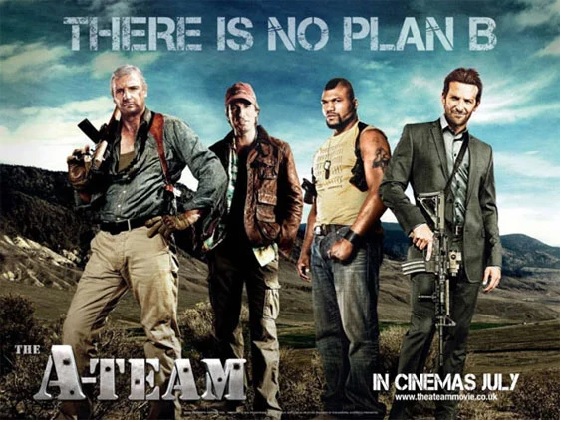
The A Team


You'd have thought the makers of The A Team (2010) had pulled their trousers down and taken a dump on the faces carved into Mount Rushmore, such is the opprobrium heaped on this film.

Now I loved TV series when I was a kid, but that doesn't mean I can't recognise it's flaws in this Eighties cultural landmark. Formulaic, and often silly to the point of farce, the series required not so much a suspension of reality as a complete detachment from it. 

How else could tens of thousands of rounds of ammunition be fired without by our heroes without once injuring, letting alone killing, someone?

So, when Exploding Helicopter reads complaints about this film's infamous flying tank scene, we say it's no more ridiculous than being imprisoned in a warehouse with a old tractor and a welding torch. Not once, but every single week.

Don't get Exploding Helicopter wrong. We're not about to launch a full scale defence of this film. The film is far from perfect, but the idea that it's an act of sacrilegious desecration is to assign an utterly undeserved status to the source material.

The film signals it's intent right at the start and you either buy in then or it's best to just abort. Interestingly for us the sequence is the key one for us as it includes a helicopter explosion.

Having requisitioned an old chopper from a hospital, the newly assembled A Team attempt to affect their escape from Mexico. They're pursued by some corrupt army officers in another helicopter.

Unfortunately, the old air ambulance the A Team are in has no weapons, so all they can do is take evasive action. This involves an aerodynamically impossible 360 roll along with some other equally implausible manoeuvres avoid some missiles.

Having used up all their tricks, it looks like the A Team's chopper is about to blown from the sky. But unbeknownst to the Mexicans pursuing them, they've now crossed into US airspace. An American jet fighter appears out of nowhere and blows the pursuing helicopter to smithereens.

Artistic merit

We enjoyed the helicopter chase sequence even if it borrowed it's aeronautic acrobatics from Blue Thunder and Die Another Day.

The explosion was well executed but it's incredibly brief and director Joe Carnahan cuts straight to the whooping reactions of the A Team in the other helicopter.

Exploding helicopter innovation

While the fighter plane's missiles are the direct responsible for the helicopter's destruction, the ultimate cause was clever use of international airspace. First known usage as far as I can tell.

Number of exploding helicopters

One.

Do passengers survive?

No. If we were talking about the tv series the answer would obviously be, 'but of course'. However, unfortunately for everyone in the chopper we're no longer in the 80s.

Positives

I'll admit I'm struggling with this one. All told this is a pretty derivative actioner. Nothing's too great, nothing's too bad.

Negatives


Liam Neeson. Does the man ever enjoy himself? He always looks pained in everything he appears in. Every time he smiles it looks like he's been cued to do it by someone shoving a hand up his backside.

Favourite quote

"Overkill is underrated."

Interesting fact

The script for The A Team was written by Skip Woods who is quickly carving out a reputation as a guarantee of exploding helicopter action. He also wrote the screenplays for X Men Origins: Wolverine and Swordfish which both feature helicopter explosions and chopper sequences.

Review by: Jafo

Wednesday, 21 December 2011

The Day After Tomorrow

The Day After Tomorrow (2004)…or The Day Hollywood Cashed In On All That Angsty Eco-Concern.

Twentieth Century Fox, never slow to recognise a cash-cow, cannily exploited growing popular sentiment on global warming by creating a movie specially designed to highlight the key concerns of green-minded people. Naturally, having seen Independence Day and Godzilla, they decided Roland Emmerich was just the man to handle such a sensitive job.

(Incidentally, the explosion-happy German later made 2012, in which pretty much everything gets destroyed, but for me the most upsetting aspect of that movie remains how closely John Cusack’s tiny mouth resembles a dog’s bum.)

So, in a nutshell: a second Ice Age is on the way and only Dennis Quaid knows it. That’s despite snowstorms in India, killer hailstones the size of medicine balls in Tokyo and tornadoes in Los Angeles. Which, at the very least, ought to have given other people a hint.

This time Dennis is a paleoclimatologist, if you’re interested. But, regardless of whether he’s buff and desert-sweaty (Flight of the Phoenix), cadaverous and louche (Wyatt Earp) or, as here, freezing his nuts off in full action mode, the dead-eyed Texan always brings an identical Will this do? quality to his roles. If acting were colour-coded, he’d be beige.

Early on, he’s repeatedly portrayed as a maverick figure, shocking high-level (even Presidential) meetings with his profound geo-revelations, but for all the tension raised he could be reading a prescription for haemorrhoid cream.

Still, that’s largely missing the point. Along with Aaron Eckhart, Quaid is one of those handy go-to men for action movies where the budget has already been spanked on special effects and the studio doesn’t want an actual personality getting in the way of all that expensive CGI.

Our multi-helicopter crash scene occurs just as the world’s weather systems collapse into freezing, snow-flurried chaos. It is also set in Scotland, which poses an obvious problem: how would they be able to tell the difference? (In fact, as the first chopper hits the ground, if you press pause you can just make out a scrawny figure wearing a short-sleeved Celtic shirt and carrying a can of Tennants in the background.)

Three RAF helicopters, helmed by the type of plummy-voiced Englishmen never heard of outside modern Hollywood movies, are heading for Balmoral Castle to evacuate the royals. But it suddenly starts to get a bit demmed perky out there, dontcha know, to the tune of minus 150 degrees.

One pilot cries out: “Bladdy fuel lines are starting to freeze, sah!” Then the rotor blades themselves quickly ice up and stop turning. A second pilot, sounding even posher, bleats: “Come on, you bar-stard!”

All three copters then spin in descending circles before crashing down onto the very soft snow at speed. Obviously, given all the fuel is frozen solid, they don’t actually explode. Clearly aware that this non-spectacle looks boring, the effects boys instead have the choppers send up huge jets of spraying snow and even have one of them come crashing directly towards the screen. As a final garnish, one of the pilots opens his door to peek out and we see him actually freeze solid before our eyes. Lummy.


Exploding helicopter innovation

It’s a decent idea. The notion of the weather suddenly turning so cold it can literally halt the rotors of a helicopter might be scoffed at as just another Wednesday by vest-wearing Neds in the Gorbals, but for the rest of us it’s a novel concept.

However, the only sweat and tears generated in putting this scene together most likely belonged to a few over-weight, under-deodorised geeks wedged in front of mammoth computers on a LA studio lot. None of it looks even remotely real, there’s zero sense of actual danger and the impossibly close angles scream out CGI botch-work.

Number of exploding helicopters

Three. (Or none, depending on how pedantic you’re feeling.)

Positives

Forget the encroaching ice, the real danger here is getting buried in clichés. Action movie buffs with a love of the obvious can sit back and relax. Cute dog. ‘Character’ vagrant. Baldy kid with cancer who makes it. Best buddy of hero who doesn’t make it. Cynical politician who admits he ‘got it wrong’. Unlikely teen crush that works out. Rousing orchestral music at the slightest provocation. It’s all here.

Negatives

Quaid – who could mangle the finest lines - is given some appalling eco-platitudes to spout. In fairness, even De Niro would struggle with such fare as: “Our climate is fragile. At the rate we're polluting the environment and burning fossil fuels, the ice caps will soon disappear.” Hearing Quaid deliver such lines, you’ll want to set fire to the nearest forest.

Interesting fact

To promote this eco-movie and its save-the-planet mantra, the leading cast members were flown, separately, around the globe on private jets, monstering up enough fossil fuel to power a small country for a year. But hey, it’s all about the message.

Review by: Chopper

Monday, 19 December 2011

Diamonds Are Forever

Is this the worst James Bond film ever? It's hard to say. Especially as there’s been considerable competition for that title down the years. But one thing’s for certain, this is a decidedly shoddy effort.

Normally, Britain's most famous spy to performs his acts of heroic espionage against a backdrop of glamorous, globe-spanning locations. However, Diamonds Are Forever (1971) takes place, almost exclusively, amidst the sterile environs of Las Vegas. 

Along the way, the viewer is left unshaken and unstirred by scenes set in a funeral parlour and at a petrol station forecourt. As for the 'big' finale, this is staged on a visibly rusting oil rig. So much for 007's license to thrill. 

Looking at the drab settings, you start to wonder if the producers didn't have much money to work with. Which, as it turns out, they didn't.

With George Lazenby hanging up his Walther PPK, Sean Connery was lured back with a whopping cheque for $1.2m. A then unheard of sum for a film, Big Tam's inflated fee was 20 per cent of the film's entire budget. No wonder there was no money for location filming or special effects work (more on that later).

Little expense also seems to have been expended on the decidedly pedestrian story. Until the finale, events unfold with little urgency. And for the most part the plot has all the scope of a private eye novel.

Still, the film is not without elements to enjoy. Charles Gray puts a great turn in as Blofeld, effortlessly oozing urbane charm with his wonderfully expressive voice. 

Also fun are the deliciously camp henchmen, Mr Wint and Mr Kidd. Their wonderfully droll double act, filled with sly menace and sarcastic eye-browed arched one-liners, provides an interesting counterpoint to Bond's typically macho posturing. 

And it's to them that we owe the film’s first helicopter explosion. They double-cross a diamond smuggler by placing an explosive inside the suitcase of cash he's come to collect. As he flies off in a helicopter, the hidden explosive detonates blowing-up the whirlybird. 

But that's not the end of the chopper fireball action. During the oil rig finale a squadron of helicopters are flown in to attack the villain's lair. The oil rig’s defences try to hold off the attack and machine guns manage to shoot down two of the attacking copters.


Artistic merit

Diabolical. The film's budget issues are all too apparent in these scenes. Previous Bond entries (You Only Live Twice, From Russia With Love) had successfully and authentically blown up helicopters using clever model work. Here the helicopters just disappear behind orange special effects blobs. 

Exploding helicopter innovation

There’s no innovation on offer in this film. If anything Diamonds Are Forever seems to be trying to take the art of exploding helicopters backwards.

Number of exploding helicopters

Three.

Positives

I love the guy who sits passively in the control room on Blofeld’s oil rig intoning the audible countdown in a thick, deadpan, German accent: “Zyx min-eeets und koun-ting!”

Negatives

Connery’s bloated pay check estimated to be around 20% of the film‘s budget. Would the helicopter explosions have looked to shoddy if they handed over so much cash?

Interesting fact

The James Bond franchise could have looked very different as the potential casting for Diamonds Are Forever shows.

George Lazenby was offered the film, but declined as he was didn’t want to sign a lengthy contract to appear in further sequels.

The producers then tried to get Michael Gambon who declined on the basis of ill health. Batman Adam West also turned down the role because he felt Bond should be played by an Englishman. American TV actor John Gavin was then signed to the role. But Gavin subsequently had his contract paid in full after the record breaking deal with Connery was struck.

Review by: Jafo

Friday, 16 December 2011

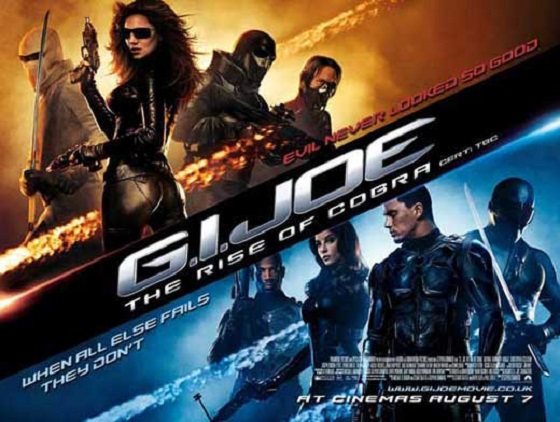
G.I. Joe: The Rise of Cobra


It’d be easy to hate this film. Existing solely to help sell children’s toys, it is the most cynical of marketing ploys. But, if you put aside your objections to this crass commercialism, GI Joe: The Rise of Cobra is actually an enjoyable film.  

The plot sees Channing Tatum, and the rest of his GI Joe team, try to stop new nanotechnology weapons falling into the hands of a global terrorist group called Cobra.  

While the dialogue is horrendous and the characters as flimsy as the toys that inspired them, the viewer does get to enjoy regular dollops of glossy action told within a clearly delineated good vs evil story. You could complain about the simplicity, but Star Wars is one of the beloved films ever made and its plot is similarly straightforward.  

All of this, though, tells us nothing about the exploding helicopters. The film opens with Cobra stealing the super-weapon. Tatum and his men are transporting it when they come under attack by Cobra’s forces.  

A futuristic shuttle craft fires a sound-wave weapon on one of the helicopters guarding the convoy. It squashes the front of the chopper and forces the rotor blades off before the fuselage bursts into flame.  

The second helicopter attempts to continue the fight, but its weapons are useless against the enemy. The Cobra craft fires another round of its odd weapon. The helicopter pilot has just enough time to say, “Oh my god” before his aircraft is destroyed.  

Artistic merit 

You can’t beat a good “What the….” moment when someone realises they’re about to die and this film serves up a doozy.  

Exploding helicopter innovation 

Is this the first known destruction of a helicopter using a sonic-gun? Certainly, the crumpling of the front of the helicopter is a *ahem* wrinkle we’ve not seen before. 

Number of exploding helicopters 

Two 

Positives 

The film finds a decent role for Adewale Akinnuoye-Agbaje who played the fearsome Simon Adebisi in gritty prison drama, Oz.  

Negatives 

The script. It really is an atrocity. 

Favourite quote 

“You’ve really tossed the caber out the park with that one.” 

This bonkers line is uttered by Christoper Eccleston who plays the villain McCullen. Presumably, the original line was something like “Hit that out the park.” I’d like to hear more common idioms given Scottish makeovers. 

Interesting fact 

Apparently, Channing Tatum was initially not keen on taking the role in GI Joe because he didn’t want to glamorise war. Fortunately for the makers of the film he had no moral objections to shamelessly glamorising children’s toys. 

Review by: Jafo

Wednesday, 14 December 2011

Black Hawk Down

Black Hawk Down depicts events which shaped American foreign policy for a decade. Not that you’d know it from this film. 

First, a quick recap. In 1993, US soldiers bungled a mission to capture militants attempting to overthrow the government of Somalia. The ensuing debacle left 19 American soldiers and unknown number of Somali civilians dead. 

Beyond the human casualties, the pictures of dead US soldiers being dragged through the streets turned the American public against intervening in foreign wars. The humanitarian consequences of this would be keenly felt in Rwanda and the Balkans.  

All which suggests that Black Hawk Down (2001) had the potential for being an interesting film. One with significant political heft. Unfortunately, someone asked Jerry Bruckheimer to produce it. 

With the ‘King of High Concept’ at the controls any thought that the film might provide a political or historical critique is swiftly abandoned. Instead we get a straight-out shoot ‘em-up. A loud ‘Huah!’ is as close as the film comes to making an intellectual statement. 

Still, as an action-fest, Black Hawk Down is a marvellously effective piece of cinema. Ridley Scott, a man whose made a career out of glossy but shallow entertainments, portrays conflict in an impressively gruesome and visceral way. The violence is brutal, sudden, unpredictable, and confused. If this is what combat like, watching this film is as close as Exploding Helicopter ever hopes to come to it.  

Complementing the visual thrills is the excellent cast. The depth of talent is a wonder to behold. Amongst stiff competition, Tom Sizemore emerges as the MVP. As a hard-ass Lieutenant he swaggers through the film in a manner reminiscent of Robert Duvall’s napalm snorting Kilgore in Apocalypse Now.   

Also faultless is the amount of helicopter action. Indeed, helicopters are central to the film - the title is a reference to the mission’s turning point. But in the first half of the film, it looks as if chopper conflagration fans are to be disappointed.  

Two Black Hawk helicopters are shot down, but neither explode. However, with members of the crew still alive, US soldiers attempt to rescue their stricken comrades. 

After fighting their way to one of the crash sites they find, there’s no one left to save. So, to stop the aircraft providing anything of value to the enemy, they plant a charge inside the wreckage blowing it up. 

The second helicopter explosion is altogether more satisfying. After freeing a trapped crew member, a soldier uses a grenade to blow-up the chopper which explodes with a rich, amber-orange fireball. 

Artistic merit 

Given the film features innumerable explosions it’s disappointing that the destruction of the first helicopter is fluffed.  

Exploding helicopter innovation 

It’s unusual to see an already wrecked helicopter explode, however, you can see examples in Courage Under Fire and X Men Origins: Wolverine.  

Number of exploding helicopters 

Two wrecked helicopters are destroyed. 

Positives 

As befits a film entitled Black Hawk Down there’s a juicy helicopter crash scene to enjoy. After the whirlybird’s tail rotor is damaged, the pilot desperately tries to maintain control of the stricken aircraft. The scene is sound-tracked by ‘mayday’ calls and angry bleeping warning alarms. 

Negatives 

Ewan McGregor plays Grimes a desk jockey who’s pressed into frontline service by the crisis. Exploding Helicopter has never been convinced that the Trainspotting star can act, so it’s little surprise that our Ewan’s extraordinary attempt at an American accent only serves to make him sound more Scottish. 

Favourite quote 

“We got a Black Hawk down, we got a Black Hawk down.” 

Interesting fact 

Eric Bana’s part was originally offered to Russell Crowe. However, he was unable to do the film and lobbied for Bana to get the part. 

Review by: Jafo

Friday, 9 December 2011

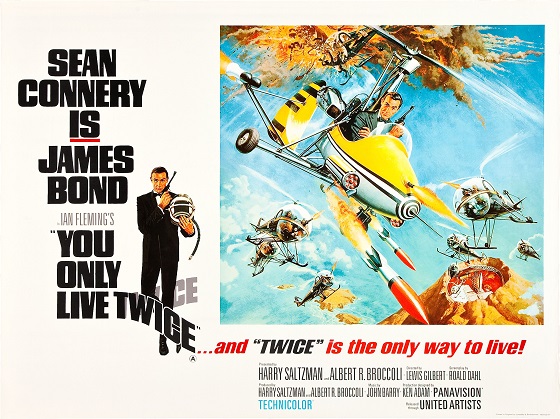
You Only Live Twice


As a kid, I used to watch the James Bond films over-and-over again. My dad had taped them off TV, and during the long summer holidays I’d work my way through the series, then go back to the beginning and start again. 

So, having engrained these films into memory I’ve very rarely felt the need to revisit them. That’s why, before this viewing, it must be around 25-years since I’ve seen You Only Live Twice.  

The experience was very strange. The film was exactly as I remember, yet simultaneously different. What my younger self had overlooked was the off-the-charts level of sexism and smut.  

“Why do Chinese girls taste different from other girls?” asks Sean Connery in the film’s opening line of dialogue, setting the tone for the relentless innuendo that’s about to follow.  

The other point which jumped out at me was the ridiculousness of Connery’s Japanese conversion. It’s the least convincing Japanese fake I’ve seen since I bought a Matsui TV.  

As was then usual, the great John Barry provides the score. And if you ask for my two pence’s worth on the subject, the music is among his best work. The Nancy Sinatra-sung theme tune is also a cracker.  

The plot, though, is pretty loose. In fact, during scene where Bond gets married and trains as a ninja for no discernible reason, it completely halts. It’s as if the scriptwriters went outside for a cigarette and told everyone to carry on without them for 20 minutes. 

So, let’s wrap up these random jottings with the some exploding helicopter talk. Bond must find Blofeld’s base, so Q introduces our hero to Little Nellie - a heavily-armed, flat-pack helicopter. 

007’s reconnoitre appears attracts the attention of four Spectre helicopters. Fortunately, in an earlier scene, Q had handily briefed Bond and the audience on the different weapons Little Nellie has. 

Bond uses the flame thrower to despatch the first helicopter, before manoeuvring above his next victim. Now it’s time for the aerial mines which float gently down on little parachutes to blow up the helicopter and its bemused pilot. 

Bond continues to make short work of Spectre’s chopper squadron by blowing-up the next with his rockets, before completing the full house by destroying the final foe air-to-air heat-seeking missiles. 

Artistic merit 

Top notch, especially as you don’t often get to see an aerial dogfight played out between helicopters. And Little Nellie’s range of weaponry means we get to enjoy diverse methods of destruction.  

Exploding helicopter innovation 

First known use of a do-it-yourself helicopter. And aerial mines. I’ve never seen them before or since. 

Number of exploding helicopters 

Four. Which ranks it highly in the list of films with multiple exploding helicopter, alongside Broken Arrow, Rambo III, and Independence Day. 

Positives 

Helicopter fans get a nice treat during a car chase earlier in the film. Agent Aki (Akiko Wakabayashi) calls up a big Chinook helicopter equipped with a huge magnet to scoop up the villains car before dumping it into the ocean. 

Negatives 

Even by Bond’s standards the speed with which he moves in on his new Japanese wife after the murder of Aki is rather unseemly. Christ man, she still warm in her grave! 

Favourite quote 

“Little Nellie got a hot reception. Four big shots made improper advances towards her, but she defended her honour with great success.” 

Interesting fact 

You Only Live Twice is the only Bond film where 007 does not drive a car. 

Review by: Jafo

Still want more? Then listen to the Exploding Helicopter podcast episode on You Only Live Twice. Listen via iTunes, Acast, Sticher, Spotify or right here.