Wednesday, 22 August 2018

Mission: Impossible - Fallout

It's a wonder that Tom Cruise is still making Mission Impossible films.

Not because of declining box office returns or increasingly critical reviews. No, it’s simply that the Cruiser should surely be dead by now.

Whereas other leading men of a similar age are opting for a more sedentary career route, Hollywood’s favourite hyperactive fifty-something has spent the past year running, fighting, crashing, crawling, stunting and, yes, actually breaking his leg in the name of movie-making.

Indeed, having turned the franchise into a global phenomenon by performing all his own stunts, Tiny Tom is now trapped in a cinematic kamikaze spiral where he has to perform increasingly dangerous feats – hurtling off the world’s tallest building, strapping himself to an actual flying plane – merely to maintain the audience’s interest.

That’s why, four years away from his bus pass, his preferred mode of transport, rather than catching the No. 46 to Safeways, is dangling off the landing rails of a flying chopper while a grinning baddie repeatedly stamps on his hands. You get tired just watching him.

The plot

You’ll never believe this, but stolen nuclear material is about to fall into the hands of devious terrorists. (Copyright: every espionage movie, ever.) Of course, Ethan Hunt faces the usual piston-armed race against time to get it back.

However, this predictable premise is given a welcome twist by the reappearance of creepy Solomon Lane (the villain from Rogue Nation). And then Hunt himself becomes the chief suspect for masterminding the entire plutonium plot. Crikey.

The cast

Like an old pair of slippers, the cast has a reassuring, comfortable familiarity.

As usual, Thomas Mapother IV - as he doesn’t like to be known - heads up the whole affair. Despite careering at speed towards his 60th birthday, he hyperactively bounces through the film in a manner that suggests he’s doing something highly illegal with monkey glands.

Alongside him is Ving Rhames, the only other survivor from the first impossible mission. While Cruise remains oddly preserved, the passage of time has not been so kind to Big Ving, whose broadening visage has now taken on a slightly unreal, waxy quality – almost as if he were wearing one of the film’s famous rubber masks.

There’s also a role for franchise newcomer Rebecca Ferguson – whose turn as a British agent was the undisputed highlight of Rogue Nation. Once again, she oozes cool allure, pounding henchmen into hamburger meat and speeding through Paris in motorcycle leathers. And for all the double-crossing and secret identities, she’s the only one here likely to be mistaken for someone who can  act.

Which is just as well, since she has to pull off one of Hollywood’s toughest thesping gigs: portraying a plausible love interest for that demented-smiley-Scientologist-couch-jumper, Cruise. (She fails, of course, but it’s a feat no-one has convincingly pulled off in over 20 years).

Last, and we definitely mean last, is the joyless Simon Pegg. Introduced as a spoddy computer geek in M:I 3 to provide a few LOLs between the main action set-pieces, the scrawny comic has inexplicably been promoted to Cruise’s right-hand man.

This is unquestionably a bad thing. Where Pegg’s painful punchlines were once safely confined to a few brief scenes, his mirth-free mutterings are now an integral part of each film.

And true to form, Fallout opens with Pegg indulging in some tortured ‘banter’ with Tom and Big Ving, which only ends when heavily armed terrorists turn up. Sadly, they don’t take the opportunity to put a bullet through Pegg’s forehead.

Is this any good?

Exploding Helicopter always likes to have a little a fun at the expense of the film and the actors we’re watching. But here’s the truth – Mission: Impossible – Fallout is a rollicking piece of entertainment.

This single movie contains more outstanding action set-pieces (a three-way fight in a toilet, a foot chase across London, the hijacking of a prison convoy) than most franchises manage across their entire series.

But M:I – Fallout is not just a rollercoaster of impressive stunt-work. It also deftly weaves in a more serious theme: the value of one life versus many.

It all adds up to a very satisfying experience, which delivers on the adrenaline-racing thrills without compromising the audience’s intelligence. In action movie terms, that makes Mission: Impossible – Fallout a rare beast indeed.

Exploding helicopter action

Naturally, given the nature of this film, the villain has come up with an overly complicated plan to detonate his nuclear bombs. And really, the tangled methodology in this one would make a Scooby Doo villain blush.

All you need to know is that the ‘McGuffin’ needed to defuse the weapons is being flown away from the danger zone in a helicopter by the rascally Henry Cavill (seen here sporting the ‘tache that cost £25m to ‘hide’ with CGI during the Justice League re-shoots).

The Cruiser gives chase aboard another chopper to set up the film’s climatic action sequence – a truly fantastic aerial duel between the two aircraft. Finally, after 20 minutes of airborne histrionics and thrills, we find TC and HC trading punches atop the fuselage of a wrecked whirlybird that’s swinging perilously on a wire off a mountain cliff edge.

With time running out before the bombs go off, Cavill finds himself in the unenviable position of hanging from wire on which the damaged helicopter is suspended. But having gained advantage, our favourite Scientology minion gives the wire a good hard yank, which sends Henry and the helicopter tumbling down the mountainside. The fuselage hits bottom and explodes.

Artistic merit

Taken as an entire sequence, this could be one of the greatest additions to the exploding helicopter canon. We get tension, visceral thrills and ultimately the satisfaction of a chopper fireball. There really isn’t any more an audience can ask for.

Exploding helicopter innovation

Watching Henry Cavill plummet to this death alongside the wreckage of a damaged chopper, Exploding Helicopter was reminded of the Cliffhanger climax where Sylvester Stallone engineers a similar demise for John Lithgow.

Favourite line

In a film where so much attention is spent on creating inventive fight scenes and geographically accurate foot-chases, it’s a shame that the same care wasn’t spent on the dialogue.

After a shootout in Paris, the Cruiser attempts to console an injured policewoman.

“Je suis desole,” he says, in a line of French so painfully rendered that it drew audible titters in Exploding Helicopter’s cinema.

Review by: Jafo

Thursday, 22 February 2018

Missing In Action 2: The Beginning

Here’s a simple question: when is a sequel not a sequel? When it’s a prequel, obviously.

But what if that film was never meant to be either a sequel or a prequel – what are we supposed to call it then?

Such terminological philosophising may seem like academic navel-gazing. How, you’re doubtless wondering, could you ever make a film without first knowing what it’s meant to be?

Ah, dear reader. You’re clearly not familiar with the weird history of the Missing In Action series.

The plot

The Vietnam War is over, but a group of American soldiers are still held as prisoners of war in a secret jungle camp.

Even though the conflict ended years ago, one dastardly prison commandant (Soon-Tek Oh) is making a point. He won’t release Uncle Sam’s boys until their leader (Chuck Norris) makes a false confession to committing war crimes.

But Chuck is made of stern stuff, his hide as thick as the triple-denim outfits he inexplicably favoured in several of his other movies. The mini-marvel refuses, so he and his men find themselves subjected to a never-ending campaign of psychological and physical torture.

So the grisly stage is set. Will Chuck crack and finally confess under his captor’s cruel crusade? Or can he and his men engineer an audacious escape? Er, yes.

You see, Missing in Action 1 – the film preceding this – was all about an ESCAPED prisoner of war, which does rather give the game away. Literally everyone watching this sequel knows exactly how things will end. Edge of your seat stuff, eh?

The cast

Given this film is notionally a sequel, the part of Captain James Braddock is once again played by Chuck Norris - the heroic and inevitably bearded leader of the American POWs.

Never the most verbose actor, our favourite beaver-in-human-form is on peak monosyllabic form here. Entire scenes take place where he does little more than grunt tersely or glower silently at his captors.

This may sound like harsh criticism, but in fact it’s high praise. Because there is perhaps no uglier cinematic sight than watching everyone’s favourite furry kung-fu pygmy trying to act. As Clint Eastwood’s Dirty Harry famously observed, “A man’s gotta know his limitations.”

Still, that’s not to say that the film is without at least one flamboyant turn. Enter Soon-Tek Oh as the vicious prison commandant, Colonel Yin. While the name may not be familiar, the face certainly will be. Mr Oh spent over 30 years playing a variety of Asian stereotypes in a *ahem* Chinese laundry list of TV shows and films. And his performance here could best be described as ‘stock Oriental villain #3’.

As the dastardly Colonel Yin, Soon-Tek is required to delight in many elaborate displays of cruelty, rage uncontrollably at his subordinates, and twizzle his moustache at the end of every scene.

Viewers of a liberal persuasion will find the performance a painful reminder of a time when Asian actors endured whole careers playing a handful of stock, cardboard caricatures.

Fortunately, we live in more enlightened times. These days, you can find a rich variety of three-dimensional Asian characters in all manner of Hollywood blockbusters. And who could find anything culturally inappropriate in top Manga movie Ghost In The Shell (starring Scarlet Johannsson), samurai classic 47 Ronin (hello, Keanu Reeves) or the Chinese fantasia, The Wall, starring, er, Matt Damon.

Sequel, prequel, what the hell should we call it?

Here’s a brief history of the chronological mess that is the Missing in Action movies. Having secured the services of Chuck Norris, legendarily tight-fisted producers Menahem Globus and Yoram Gohan were convinced that their Vietnam epic was going to be a success.

To save themselves the time, trouble, and particularly expense of returning to make an inevitable sequel, the parsimonious pair decided to shoot a follow-up at the same time. The first film would tell the tale of a brave American soldier who spent years in brutal captivity before escaping. The sequel would show our hero returning to ‘Nam to free other POWs.

Shooting commenced on both movies. And all seemed to be going swimmingly, until they ruined everything by actually taking a look at the dailies. Because while they had in fact made a very good movie – a bona fide smash, probably – it was the second one that worked. The first movie, the one meant to launch the whole mini-franchise, was a merde-ball, a dog’s dinner, an absolute stinker.

Realising that audiences would never watch their gem of a sequel if they’d been scarred by a terrible first film, the producers hatched a cunning wheeze: simply release the sequel first.

So, Missing In Action 2 became Missing In Action, while the original was rebadged as Missing In Action 2 with a handy subtitle – The Beginning – to explain the bonkers timeline to bamboozled viewers. Confused? Just wait until you hear about Missing in Action 3. (More of that later).

Why is it such a stinker?

What was it about this film that panicked producers so much? Put simply, Missing In Action 2 is possibly the most schizophrenic film Exploding Helicopter has ever witnessed. Individual scenes veer chaotically from daytime soap opera emoting to stomach-churning violence. (Picture Harold and Madge from Neighbours having a delicate squabble over the barbie, then Madge opening her hubby up stomach-to-throat with a flensing knife. It’s that kind of tonally awkward.)

One minute the POWs are swapping tear-jerking stories about their pregnant gals back home, the next Norris is suddenly biting the head off a rat. It’s very disturbing.

Having said that, given the choice between watching Wee Chuck floss his sizeable gnashers with rodent entrails or attempt some more ‘acting’, most viewers would probably choose the furry innards.

Exploding helicopter action

Generally speaking, Vietnam War films are a mecca for helicopter fans. You can barely get through five minutes of most ‘Nam movies without hearing the steady ‘thum-thum-thum’ of rotor blades as an open-sided chopper swings into shot. And many end up in flames.

So it’s no surprise to see the film open with our diminutive hairy star and crew flying low above the Vietnamese jungle in a chopper. And even less of a surprise when they come under heavy fire.

The whirly bird is fatally damaged and unable to land, so Chuck and his men bail out – jumping into a river they seem to handily be flying over. Without anyone at the controls, the stricken copter crashes into the ground and explodes – becoming yet another casualty of war.

Artistic merit

This is one horrible helicopter explosion. As the aircraft nears the ground, it suddenly disappears behind a very artificial-looking ball of flame.

Clearly embarrassed by the poor quality of his composite shot, the director wisely lingers but a moment on the fiery cloud before cutting away.

Exploding helicopter innovation

You don’t often see pilotless helicopters explode. The only other one that springs to Exploding Helicopter’s mind is in Piranha II: The Spawning.

Tagline

“An American hero’s story continues,” boasts the film’s poster, ignoring the fact this is a prequel. Then again, “An American hero’s backstory is completed” isn’t terribly catchy.

Interesting fact

After the first two films, you’d think it would be hard for the series’ chronology to become yet more convoluted. But that’s what happened with Braddock: Missing In Action 3 (1988).

In Chuck’s third ‘Nam outing, the long years of captivity are altogether expunged from his character’s history. (In a breath-taking flashback, we even see him airlifted home at the end of the war.) Worse, he’s suddenly given a Vietnamese wife and child who have hitherto never been seen nor mentioned, and whose existence flatly contradicts the entire events of MIA 2.

Not since a very-much-alive Bobby Ewing wandered out of the shower in Dallas (rendering the 31 episodes preceding his very noticeable death redundant), has Exploding Helicopter seen such a cavalier attitude to continuity.

Review by: Jafo

You can read a review of Missing In Action 2: The Beginning by our buddies over at Comeuppance Reviews.

Tuesday, 23 January 2018

Money Talks

As its title suggests, Rush Hour (1998) hit cinemas like a shot of adrenalin and got audiences feeling very giddy indeed.

In truth, hopes had not initially been high. A variant on the buddy cop formula (copyright: Walter Hill and 48 Hours), the film teamed gobby joke-smith Chris Tucker with martial arts legend Jackie Chan for the usual squabbling-then-bonding shtick.

But audiences loved it. An unexpected box office smash, it spawned two hugely profitable sequels that improbably transformed Tucker into the world’s highest paid actor. (The fact he pocketed $25m for Rush Hour 3 is by some way the funniest thing about that particular film.)

To most people, the helium-voiced comic appeared to spring from nowhere. But he’d actually given his sidekick skills a dry-run in an earlier, now largely forgotten film – Money Talks (1997).

The plot 

An unscrupulous TV reporter (Charlie ‘Winning’ Sheen) engineers the arrest of a small-time conman (Tucker) to create a story for his news channel.

But as the luckless thief is being taken to jail, he’s unwittingly caught up in a prison break when a criminal kingpin is sprung from chokey. The famously unforgiving LA police, mistakenly believing him responsible for the death of several officers, vow to bring in the hapless crook ‘dead or alive’ (with a pointed emphasis on the dead).

Hunted across the city and desperate to prove his innocence, the wronged felon turns to an unlikely source of help: the shady journalist who landed him in this mess in the first place.

The perfidious pair partner up. Can the criminal clear his name? Will the heinous hack get an exciting exclusive? Will this movie avoid shoddily mining every single buddy cop cliché in the book? No.

Falling star 1…

By playing fast-talking crook Franklin Hatchett, Chris Tucker found the perfect foil with which to reprise the motor-mouthed monologues that had made his stand-up act such a success. Although how the jibbering joker ever became a top comic remains a mystery to Exploding Helicopter.

His trademark rapid-fire repartee seems born not so much from an urgent need to share the zinging punchlines percolating in his head, but rather to obscure the fact that nothing he says is terribly funny. He’s the comedy version of a hamster on a wheel – expending huge amounts of energy but going nowhere.

Worse still, the stream of consciousness word-blurt is delivered in a migraine-inducing falsetto. Screechy and speedy but never funny, Tucker’s whole career is a triumph of sass over substance.

Falling star 2…

Talking of sass over substance (abuse), Charlie Sheen’s turn as the unprincipled newsman has to be seen to be not at all believed in. Now, coming across as a complete dick has rarely been a problem for Carlos Estevez, not because he’s a good actor but because he’s a complete dick.

Indeed, the coke-snorting wife-beater’s most profitable period as a thespian came while playing a sanitised version of himself in the hit TV series, Two and a Half Men. Sadly, his newfound popularity convinced the Platoon star – who once ‘accidentally’ shot a fiancĂ©e - that what his viewers really wanted was to see more of the ‘real’ him.

And in fairness, he did deliver. Looking through its fingers, mainstream America watched on as Sheen got himself fired, shacked up with two porn stars (then beat one of them up), and had an unforgettable drug-fuelled meltdown on national TV. Of course, all this happened after ‘Money Talks’. But watching the movie, you can already see that this is exactly the kind of guy such things would happen to.

Buddy movie breakdown

The buddy movie formula is painfully simple: shove two contrasting personalities together, then sit back and watch the sparks fly. The only real rule is that, while the partnered protagonists aren’t meant to like each other, the audience should find one or other of them appealing (or at least be amused at their sparring).

That clearly was an ask too far for ‘Money Talks’ and its hapless director, Brett ‘Fatty’ Ratner – a plodding cinematic journeyman whose mantra should be: ‘Will this do?’ Against the odds, Ratner manages to give us two irritating characters, played by two unlikeable actors, in an adventure you care little about.

Exploding Helicopter lays no claim to be a film scholar, but we’re pretty certain that’s no recipe for enduring success.

Exploding helicopter action 

Still, at least there’s a helicopter explosion. The pivotal scene takes place at the LA Coliseum during the film’s big climax. Our *ahem* heroes are pursued by two rival gangs who each want a cache of stolen diamonds (a sub-plot too tiresome to explain) that Tucker has in his possession.

As a massive gun battle breaks out, Sheen cleverly uses hand-grenades to booby-trap a helicopter belonging to one of the villains. When the police arrive, the baddie tries to make an aerial getaway. But the chopper’s take-off triggers the hidden explosives, creating a fireball that consumes the helicopter.

Artistic merit 

It’s always nice to see a villain’s despairing death throes and Money Talks treats us to a fine example of the form. As flames envelope the whirlybird’s fuselage, the desperado recognises his imminent fate and screams a despairing “Noooo….” before he too is turned to ashes. Quality stuff.

Exploding helicopter innovation 

Exploding Helicopter appreciated the clever and unique way in which the chopper was rigged to explode.

Basically, Sheen pulls the pins from several grenades and jams the now primed devices under the copter’s landing skids. As the chopper takes off, the pressure on the grenades’ levers is released causing them to detonate. Ingenious. 

Interesting fact 

After making Money Talks, Chris Tucker became a born-again Christian. It’s still not known whether God has forgiven him for this risible tosh.

Review by: Jafo

Tuesday, 7 November 2017

When Eight Bells Toll

Sir Anthony Hopkins is no-one’s idea of an action hero.

Short, mumbly and shuffling, even in his prime the Welsh luvvie hardly exuded the flinty toughness of Seventies icons such as Lee Marvin or Charles Bronson. His appearance always suggested awkward college professor rather than iron-jawed super agent: he was more woolly cardigan than sharp tuxedo.

And yet, back in the early Seventies, a couple of Hollywood producers bafflingly decided he was just the man to lead an explosive new spy series. One that would strip James Bond of his licence to thrill.

Obviously, it must have seemed a good idea at the time. But as the twenty-fifth Bond film rolls into production, the sequel to When Eight Bells Toll (1971) still remains curiously absent from our screens.

The plot

When a series of ships carrying millions of pounds’ worth of gold bullion goes missing, Philip Calvert - a ‘maverick’ (natch) naval intelligence officer - is ordered to investigate.

Our nautical hero’s search takes him to the remote coastline of the Scottish Isles. Once there, he comes across wealthy shipping magnate, Sir Anthony Skouras, who not-at-all-suspiciously has decided to moor his luxury yacht among the pissing rain and howling winds of the Inner Hebrides. Instead of, say, Monaco.

As a top intelligence officer, Calvert detects something fishy in Skouras. (Plus, the only other living creatures within 200 miles are three inbred farmers and a few thousand sheep, so the suspect list is not extensive.)

With a target in his sights, Calvert sets about the task of stolen treasure hunting. Can he find the missing loot? Is Skouras really the mischievous mastermind behind the mystery? What might happen when eight bells toll? And will there ever be a sequel? No.

Who’s in this?

First question: how on earth did Wee Tony land this particular gig? And if he was the best option, who else must have been on the shortlist – John Cleese? Christopher Biggins? But not so fast, sceptical reader. Actually, there was a wonky logic to the casting.

At the time, our Tony was a sizzling talent on the London stage, seen as intense, edgy and brooding. So the producers reasoned he had the goods to create a grittier, moodier spy hero to rival 007’s increasingly fantastical exploits.

What they didn’t consider is that it’s much easier to appear tough on a stage where everyone else is wearing tights and saying ‘Hey, Nonny’, than it is in a movie where grown men are trying to kill you.

So while the dimunitive Taff brings a suitably flinty edge to his spoken scenes with arrogant superiors and lofty villains, ultimately that’s still Wee Tony swinging his little paws about in the fight scenes. Daniel Craig, he is not.

Playing the baddie is Jack Hawkins, that pug-faced star of Fifties British cinema, who earned international acclaim for his performances in The Bridge Over The River Kwai and Ben-Hur.

By the Sixties, both poor Jack’s career and health were on the wane. Diagnosed with throat cancer, Hawkins had his entire larynx removed, which robbed him of his distinctive voice. (Think: constipated Mongolian throat yodeller).

Here, as in many films at the end of his career, a sickly-looking Hawkins (who could only speak with an electronic voice-box) is dubbed by the mellifluously voiced Charles Gray. It’s a sad sight to see the once powerful actor appearing as such a pale shadow of his former self.

Is this any good? 

While Eight Bells Toll does have a certain ap-‘peal’ (see what we did there?), it also ‘rings’ a few false notes.

The basic plot - an underwater search for missing gold - is fine. Swap the ingots for nuclear weapons and you essentially have Thunderball.

But that film was set on the sun-kissed shores of the Bahamas and played out against a background of Caribbean carnivals, colourful henchman and beautiful damsels. This film takes place among the cold, wintery waters of the North Sea. When the only people wearing skirts are gruff, knobbly-kneed Scotsmen trying to kill the tiny hero, you know you’re in trouble. It couldn’t be less glamourous.

Exploding helicopter action 

But still, there is at least one scene which we care about: the exploding helicopter. In an effort to find the gold, Hopkins conducts an aerial search in a chopper. As he surveys the coastline he runs into a posse of heavily armed villains who open fire on the whirlybird with machine guns.

The gunfire damaged helicopter spirals downwards, crashing onto rocks next to the shoreline. The tail of the helicopter explodes, but the cockpit remains intact. As flames start to consume the fuselage, Hopkins finds himself trapped inside the crocked copter.

The jeopardy increases when the wrecked whirlybird slips from the rocks and plunges into the sea threatening to drown our hero. As the cockpit fills with water, Sir Anthony is finally able to free himself and swim to safety. Phew!

Exploding helicopter innovation 

The method of destruction – machineguns and crash landing – is very familiar territory for any self-respecting chopper fireball aficionado. But Exploding Helicopter enjoyed the way the scene teased with a tempting twosome of first a fiery and then a watery death for our hero.

Interesting fact 

The term "eight bells" is a nautical reference to the hour of midnight.

Review by: Jafo

Sunday, 24 September 2017

Arabesque

With Charade (1963), a light-hearted Hitchcockian mix of mystery, romance and comedy, director Stanley Donen earned a deserved box office smash.

So hopes were high when, three years later, Arabesque hit cinema screens with the same formula of Hollywood stars, glamourous European locations and a racy espionage plot.

But where the first movie deftly mixed its ingredients into a delicious, light confection, Arabesque served up a congealed mess – the cinematic equivalent of school dinner mashed potatoes.

Plot

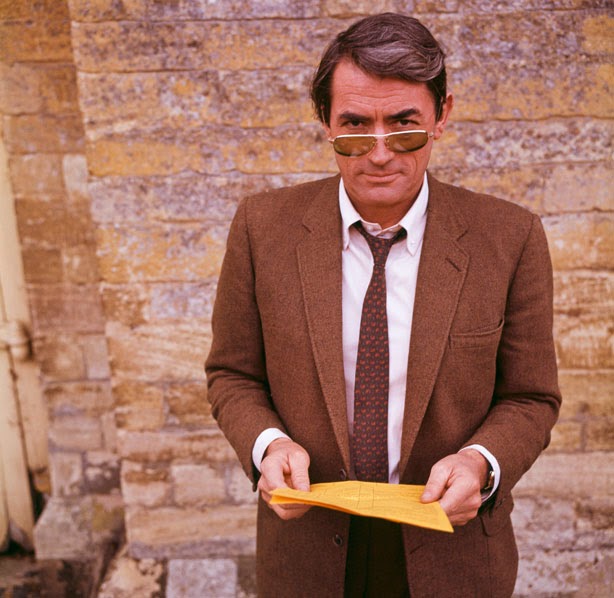
An Egyptology professor (Gregory Peck) finds himself at the centre of international intrigue after he’s hired by a mysterious Arab (Alan Badel) to decipher some hieroglyphics. (Naturally, Badel is in fact Caucasian, but absolutely nails the ‘Arab’ part thanks to some dusky make-up and a ridiculous, panto-villain accent.)

The seemingly innocent code-breaking takes a sinister turn when Badel’s girlfriend (Sophia Loren) warns Peck he’ll be murdered once he’s decoded the message. Fearing for his life, gangly Greg – whose real name was Eldred, fact fans – absconds with Loren, only to be pursued by Badel’s goons.

Admittedly, this fulsome-sounding summary scarcely covers the first 20 minutes of the film. But by common consent, Arabesque has a torturously complicated and unwieldy plot. (Greg may have solved the pharaonic riddle, but no bugger alive can work out what’s happening by Act Three.) So for the sake of brevity (and your sanity), let’s leave it there.

Suffice to say, the rest of the film involves much regulation issue double-dealing, sinister skulduggery and murderous mayhem as a bevy of unsavoury villains try to get hold of the ancient text and its secrets. And the audience tries to figure out just what the buggery is going on.

Who’s in it?

Gregory Peck plays the bookish academic who becomes unwittingly embroiled in this imbroglio. With his dark looks, formal manner and patrician air, Greg was made for austere roles that emphasised much troubled scowling and deep, introspective brooding.

But for this light-hearted caper, he’s obliged to deliver droll one-liners, engage in a whirlwind romance and insouciantly dodge danger. It is by no means a comfortable fit. Imagine Werner Herzog starring in Police Academy 7 and you’ll get the idea.

In fact, as you watch Eldred shuffle awkwardly through the film, it’s hard to not think that rascally charmer Cary Grant would have been much better for this role.

And as it happens, that’s an opinion shared by the film’s director, Stanley Donen, who’d had the part specially written for the North By Northwest star but was then unable to secure his services. Rubbing salt in the wounds, apparently dour Gregory, every time he flubbed his lines during filming (which was often), liked to remind Donen: “Remember, I’m no Cary Grant.” Ouch.

Co-starring in the film is Italian beauty Sophia Loren, widely considered one of cinema’s greatest female actors. Not that you’d know it from her Hollywood output, though.

While her European CV is full of award-winning performances in meaty, issues-led dramas, Tinseltown invariably cast her as exotic eye candy in insubstantial bits of froth. Like this movie.

And Loren’s turn here – oozing allure in a progressively outrageous array of glamourous outfits – largely renders this talented actress little more than a glorified clothes-horse.

Still, the role does bring one significant challenge. Because our long-legged lovely is called upon to look hopelessly smitten by fifty-something Eldred, while he awkwardly exudes all the sexual charisma of a kitchen fridge.

A puzzle, wrapped in a mystery, shrouded in a very confusing film

Readers who’ve made it this far (and Exploding Helicopter thanks both of you) will already have gleaned some of the reasons Arabesque doesn’t work.

The plot – and it’s hard to overstate this – is hopelessly convoluted. It’s never entirely clear what is going on, or why Peck – a fusty academic who spends his day reading dusty scrolls – continues risking life and limb to solve a mystery that neither he, or the audience, understand.

Further befuddlement is added by director Stanley Donen. In previous films, such as On The Town and Funny Face, he’d always directed in a conventional style. But he photographs Arabesque as if he’s just dropped a tab of LSD, swamping the screen with psychedelic colours, crazily angled shots or peculiar framing. It’s like totally groovy man!

Sadly, it turns out our Stanley wasn’t having a mid-life crisis or experimenting with a new style: his reasoning was entirely cynical.

After spending $400,000 dollars on script rewrites, he realised the story was still utterly incomprehensible. “Our only hope,” he confided to the film’s cinematographer, “is to make the film so visually exciting the audience never have time to work out what the hell is going on.”

Exploding helicopter action

Still, Arabesque does get some things right. And by that we mean the inclusion of an exploding helicopter.

During the film’s big climax. Peck and Loren are being pursued across the countryside by the villainous Badel, who’s aboard a Bell 47J Ranger with some machinegun-wielding goons.

Our heroes escape takes them to a large iron bridge that is currently undergoing repairs. They run on to the bridge while the baddies take pot-shots from the chopper swooping above.

Clambering down onto a gangway on the metallic structure, Peck finds a ladder that’s been left by maintenance workers.

As the helicopter flies underneath the bridge to make another pass, Greg drops the ladder into the whirlybird’s rotor blades. The damaged chopper spins off, before crashing into the river below and exploding.

Artistic merit

Judged against today’s standards the scene is pretty terrible. The special effects involve the use of a very obvious model helicopter and some extremely ropey back projection. However, allowances need to be made for the fact that this is one of cinema's earliest exploding helicopters (only two films predate it, From Russian With Love and The Giant Behemoth).

There are some nice shots from inside a real helicopter showing the panicked passengers as the aircraft plummets, out of control, towards the ground. Curiously, someone decided to add in that high-pitched whining sound effect you typically get when planes crash. It’s highly doubtful that the aerodynamics of a plunging helicopter would actually generate this noise, but what the heck.

The shot of the fuselage hitting the surface of the river and breaking apart does look good. As does the fireball it generates. Weirdly, part of the wreckage appears to be on-fire and underwater at the same time. It’s a while since Exploding Helicopter took a GCSE in science, but we’re not sure that’s possible.

Exploding helicopter innovation

Only known destruction of a helicopter by a ladder.

Interesting fact

Legendary Hollywood stuntman Vic Armstrong – listed in the Guinness Book of Records as the world's most prolific stunt man – earned his first screen credit on this film as Gregory Peck's stunt horse-riding double. But Greg did all his own worried scowling.

Tagline

Ultra mod, ultra mad, ultra mystery.

Review by: Jafo

Still want more? Then listen to the Exploding Helicopter podcast episode on Arabesque. Listen via iTunes, Podomatic, Stitcher or YourListen.


Friday, 25 August 2017

The Alternate

A team of thieves-posing-as-terrorists take the occupants of a tall building hostage. One grizzled law official leads the fightback – climbing lift shafts and swinging around outside the building. All the while helped by a buddy cop down on the ground.

Sound familiar? Yup, you guessed right: it’s The Alternate (2000). Why, what else were you expecting?

Similarities to, ahem, another hostage building-based movie are of course entirely intentional. The marketing blurb on the cover even makes a feature of its plagiarism, proudly boasting: ‘In the tradition of Die Hard’. Presumably, in much the same way those knock-off sports vests with upside-down ticks are ‘in the tradition of’ Nike. You have to admire the chutzpah.

Still, we shouldn’t be churlish. Who doesn’t want to watch another movie filled to the brim with expertly choreographed action, pulse-quickening drama and witty one-liners? Unfortunately, this isn’t it. What you get here is more Try Hard than Die Hard.

The plot

While hosting a charity function, the American president is taken hostage by a group of terrorists. But unbeknown to POTUS, the abduction is actually a PR stunt to boost his re-election campaign. (Quite what the Prez has done to get himself in lumber with the voters isn’t specified. But it’s no doubt much more serious than publicly mocking disabled people, championing white supremacists, or bragging about grabbing strangers vaginas, because these days such actions are guaranteed ratings winners.)

Anyway, as is often the way with smart movie plans, something goes wrong. Unsurprisingly, one of the ‘fake’ kidnappers realises there’s much more money to be made by genuinely grabbing the commander-in-chief and demanding a humungous ransom.

All looks lost. But luckily for the fate of the free world, a ‘maverick’ CIA agent is on hand to save the day.

The cast

Eric Roberts: once a hotly tipped young gun
Let’s call a spade a spade. Much like Alan Rickman’s baddie (though with none of his roguish charm), this movie sets out to commit a daring, wholesale robbery – namely of the plot and characters of Die Hard. So let’s look at the actors, such as they are, through the prism of the Bruce Willis classic.

In the John McClane role, we have jobbing actor-for-hire, Eric Roberts. Yes, that Eric Roberts. The one who started out as a hotly-tipped young gun in such well-regarded movies as The Pope Of Greenwich Village and Star 80.

And yes, the one who, after some spectacular substance issues and a series of poor career choices (and let’s face it, one problem may well explain the other) saw the juicy roles dry up. Today, the one-time Oscar nominee is mostly known for being Julia Roberts’ estranged older brother.

Unusually, the role of ‘happy, friendly cop on the ground’ has here been taken by gravelly grumbler and sometime ear-slicer, Michael Madsen. Long known as one of Hollywood’s laziest actors, Big Mike has been phoning in performances for straight-to-DVD junk such as this for over two decades.

But perhaps his somnambulistic approach to the actor’s craft reached its very apotheosis here, as Madsen literally spends the whole movie yakking to Roberts on a mobile phone. Yet you still get the impression he can’t really be bothered.

There are many bad and lazy actors out there, but perhaps only Madsen could view the task of saying a few words into a pretend phone for a lot of money as an unreasonable ask.

Canadian B-movie beefcake Bryan Genesse
And of course no Die Hard imitation would be complete without an urbane villain to engage our hero in a compelling battle of wits. It appears that the peerless Alan Rickman must have had clashing film-scheduling commitments and been unable to grasp at this career opportunity gold. So instead we have Canadian B-movie beefcake, Bryan Genesse (Cyborg Cop III, Cold Harvest).

Genesse plays a rogue CIA agent whose blackmail plan requires him – at various points in the film – to pretend to be an Arab terrorist called Ahmed. In order to keep the ruse going, big Bryan puzzlingly adopts a French accent whenever speaking as the not-obviously-Gallic extremist. (When you think about it, Le ISIS doesn’t really have a ring to it.) It’s all hopelessly confusing.

Given such a dog’s breakfast of a character and such painful dialogue, most actors might simply shrug their shoulders and console themselves with this thought: “Hey, I didn’t write this.” That’s not so easy for ‘Le Bryan’, however: he penned the script.

Die Hard try hard

For all its Die Hard similarities, The Alternate does have a unique if rather surreal spin on the whole ‘terrorists in a tower block’ trope.

For instance, we’ve yet to see Bruce Willis electrocute a henchman by booby-trapping a cup of coffee, or fight off a female villain wielding – I kid you not – a sharpened lipstick.

These scenes are mere preludes though, for the film’s action coup de grace. This sees Eric Roberts engage Bryan Genesse’s baddie in a machine-gun duel while swinging across a swimming pool on piece of bunting. It may sound terrible – and indeed it is. But console yourself that it’s still not quite as bad as anything in A Good Day To Die Hard (whose reviews contained such high praise as ’crassly opportunistic’, ‘irrevocably stupid’ and ‘like a near-death experience’).

Exploding helicopter action

Part of Genesse’s plan involves faking his getaway, and making the world believe he died in a big explosion. (Yup, there really isn’t a single Die Hard plot device this film doesn’t snaffle for itself.)

In an extraordinarily convoluted sequence, our rogue-CIA-agent-turned-French-Arab-terrorist-impersonator makes an escape by flying off from the roof of the hotel in a helicopter. But wait! As he does so, Genesse jams the controls of the chopper and – unseen from the ground – jumps from the whirlybird back onto the hotel’s roof.

As the aircraft comes into view of the police, one of them pulls out a rocket launcher (apparently standard issue for the LAPD) and fires it at the chopper. Whereupon it crashes to the ground and explodes.

Artistic merit

Horrendous. It looks like the shell of an actual helicopter is dropped on to the road (presumably from a crane). But once it hits the asphalt it disappears in an entirely unconvincing cloud of CGI. Risible.

Exploding helicopter innovation

It’s not often that you see a pilotless helicopter explode. Other examples can be seen in Piranha II: The Spawning and Angels & Demons.

Interesting fact

Ice T has a small role in the film as a secret service agent whose only notable contribution to the film is yell: “Prepare for all surprises, assassination is not in my goddamn vocabulary!” Moments later, inevitably, he is bumped off.

That isn’t the end of the indignity for the rapper-turned-actor. As one of the ‘star’ turns in the film, his name appears on the cover of the DVD above a picture of someone who very clearly isn’t Ice T.

Apparently, whichever jobsworth lazily photo-shopped the cover design used a picture of the only other black man in the cast.

It’s an ugly mistake to be sure, but a perfect metaphor for the film. When you can’t even get the cover details right, what hope is there for the actual movie? So take Exploding Helicopter’s advice. If you’re tempted to watch this movie, try the Alternate instead – and just stick to Die Hard.

Review by: Jafo

Friday, 4 August 2017

Behemoth The Sea Monster

During the Fifties, cinemagoers just couldn’t get enough of the sight of mutant monsters destroying American cities.

Barely a week went by without some radioactive, scaly monstrosity laying waste to yet another bustling metropolis. It was the age of the ‘creature feature’.

But after San Francisco was mangled by a giant octopus (It Came From Beneath The Sea), Los Angeles invaded by super-sized ants (Them!) and New York reduced to rubble in The Beast From 20,000 Fathoms, moviemakers found themselves with an awkward problem.

Having effectively demolished the United States, there was nowhere left for their boisterous, building-bothering beasts to run amok. Then someone had a bright idea: why not shift the action across the Atlantic and have their latest atomic doom-monger destroy London instead?

And so, Behemoth The Sea Monster (1958) was born. Or, in this case, reawakened from its prehistoric slumber.

The plot

When thousands of dead fish mysteriously wash up on the beach of a Cornish fishing village, two plucky scientists are sent to investigate.

At first they can find no logical explanation. But after encountering further strange events, the boffins finally learn that a giant radioactive dinosaur is on the loose. Which, in fairness, would explain the fish. What’s worse, it appears that the skyscraper-sized horror, like many a naĂŻve newcomer to these shores, has decided London is absolutely the place to be. (Clearly, it hasn’t heard about the tube congestion and outrageous rents.)

A nation gravely waits. Will the foul behemoth next trample the Houses of Parliament, break up Buckingham Palace, use Nelson’s column as a toothpick? Perhaps Blighty’s last remaining hope is that the monster lands in Hoxton and consequently disappears up its own arse.

Still, with the Big Smoke facing imminent destruction, it now falls to our scientific heroes to stop the radioactive menace. If the beast is to be defeated, then our plucky heroes will have to come up with a last-minute heroic act of derring-do in the very nick of time. As happens in every one of these monster movies. Really, the tension is almost non-existent.

Who’s in this?

Gene Evans and Andre Morell
Having shunted the action to good old Blighty, the producers were clearly keen to emphasise the point by giving a prominent role to a British stereotype.

Enter Andre Morell. He plays the scientist leading efforts to stop the monster. With his plummy voice and urbane manner, Morell enjoyed a profitable career playing upper class officer types throughout the Fifties and Sixties (most notably in The Bridge On The River Kwai).

But, wisely calculating that no-one wants to see Godzilla vs the Chinless Toff, Morell is partnered with American B-movie tough Gene Evans. With his craggy face and whiskey-soaked voice, our Gene was normally found growling his way through war movies and westerns.

Here, he’s unconventionally and unconvincingly cast as a radiology expert. Stiffly shuffling around a laboratory, awkwardly delivering mouthfuls of pseudo-science, Action Man Evans’ discomfort is plain to see. He’s clearly longing to throw off his lab coat and bayonet another Nazi or wrestle a tomahawk wielding Indian. So, when the film’s denouement requires a volunteer to take on the sea monster in a submarine, it’s no surprise to see whose hand goes up for the job.

A little local difficulty

The Giant Behemoth, another unwanted American tourist
Anyone who’s watched a few monster movies will likely think they know how the plot runs: monster emerges from the ocean’s depths, stomps on buildings, and sends the civilian population into a hysterical panic.

But those films weren’t taking place in Britain – home of John Bull, the stiff upper lip and that famous English reserve. Rather than run screaming from a radioactive giant that has just squished his house, the average Englishman is more likely to stand his ground and enunciate: ‘I say. That’s a bit rich.’

So when the radioactive dinosaur starts marching across England’s green and pleasant land, it doesn’t encounter the usual cowering populace. Oh, no. In fact, its first encounter is with a ruddy-cheeked, trigger-happy farmer who tries to see off the beast with his trusty shotgun. Literally: ‘Get orf my land!’

It quickly becomes apparent, in fact, that our heroes’ main battle may not be with the creature at all but with Britain’s government, who remain singularly unmoved by the threat they’re facing.

After laying out their plan to tackle the monster, one decidedly unimpressed Whitehall mandarin huffs and comments: “All this? For an oversized crocodile?”

Very droll. But while such moments may accurately reflect the stuffy calm of the British character, they do rather rob the film of sense urgency.

Exploding helicopter action

The doomed helicopter about to make cinematic history
During the film, an aerial search for the beast is launched by a couple of expendable extras in a Westland WS-51 Dragonfly. (These unlucky chaps are the Fifties monster movie equivalent of the Star Trek crew members in red jumpers who teleport down to an unknown planet with Captain Kirk. You just know they won’t need a return ticket.)

Our pilots locate and close in on the creature which uses its radioactive powers (which the film never actually specifies) to destroy the helicopter.

One moment the aircraft is there, the next there’s an intense white glow and sudden shower of sparks. And poof! It’s gone.

Artistic merit

Cinema’s most significant trope had to begin somewhere, but it’s a pity such a momentous cinematic tradition began with such a modest example.

History is made, cinema's first chopper fireball
The special effects are about as spectacular as an indoor firework. And further marks have to be deducted for a continuity error where the helicopter - a WS-51 Dragonfly - suddenly turns into a WS-55 Whirlwind seconds before it explodes. (I know, Exploding Helicopter is terribly fussy about such things).

Still, this is film history so the director deserves credit for seeing the audience-thrilling possibilities of blowing up a helicopter in a movie. Sir, we salute you.

Exploding helicopter innovation

It all began here folks. This exploding helicopter is the earliest chopper fireball we’ve yet discovered. (Previously that distinction had been held by James Bond’s sophomore outing From Russia With Love).

It is also the only known exploding helicopter shot in black and white.

Tagline

Nobody could accuse the marketing team of underselling the film with this description:

“SEE the Beast that shakes the Earth! LIVE in a world gone mad! WATCH the chaos of a smashed civilization! FLEE from the mightiest fright on the screen! NOTHING so Big as Behemoth!”

Interesting fact

The cast here is pretty unremarkable, but British sitcom fans should keep an eagle eye out for a disturbingly young Leonard Rossiter (Rising Damp, Reginal Perrin) who has a blink-and-you’ll-miss-it bit part. No sign of ‘Oooo…Miss Jones’, though.

Review by: Jafo